
Master the Art of Pruning Trees and Shrubs in 2025
August 27, 2025
Understanding Yard Drainage Solutions for Your Property
August 29, 2025
Watering the lawn might seem as simple as turning on the hose, but the truth is that most grass only needs about one inch of water per week, including rainfall. Surprised? Many people end up either drowning their turf or leaving it parched without even realizing it. A carefully planned watering schedule does more than just keep things green and tidy—it actually protects your lawn from hidden dangers like weak roots, disease, and wasted water.
Table of Contents
- What Is A Watering Schedule For Lawns?
- Why A Watering Schedule Matters For Lawn Health
- How Watering Schedules Influence Soil Health
- Key Concepts Of Effective Watering For Lawns
- The Impact Of Climate On Lawn Watering Needs
Quick Summary
| Takeaway | Explanation |
|---|---|
| Water lawns with one inch weekly | Most residential lawns need about one inch of water weekly, including rainfall, to ensure health and prevent turf damage. |
| Irrigate early in the morning | Watering between 5-9 a.m. minimizes evaporation and reduces the risk of fungal diseases, promoting better grass growth. |
| Deep, infrequent watering is best | Encourages deeper root growth, leading to healthier, drought-resistant lawns, rather than frequent, shallow watering. |
| Consider climate variability | Tailor your watering schedule based on local weather conditions to ensure efficient water use and meet your lawn’s needs. |
| Monitor soil health and structure | Proper watering improves soil composition, nutrient retention, and promotes beneficial microbial ecosystems crucial for lawn vitality. |
What is a Watering Schedule for Lawns?
A watering schedule for lawns represents a strategic plan for providing optimal hydration to grass and landscape areas, ensuring healthy growth while conserving water resources. Unlike random or inconsistent watering, a structured approach considers multiple environmental and botanical factors to deliver precise moisture levels.
Understanding Lawn Water Requirements
Lawns require consistent and measured water application to maintain robust health and appearance. According to the U.S. EPA WaterSense program, most residential lawns need approximately one inch of water per week, inclusive of natural rainfall. This precise measurement helps prevent both under and over-watering, which can cause significant turf damage.
Key considerations for developing an effective watering schedule include:
- Grass type and its specific water tolerance
- Local climate and seasonal variations
- Soil composition and drainage characteristics
- Current temperature and humidity levels
This table summarizes the key factors affecting lawn water requirements, as highlighted in the article, to help readers quickly identify what determines optimal irrigation for their yards.
| Factor | Description |
|---|---|
| Grass Type | Different species require varying amounts of water and drought tolerance |
| Local Climate | Temperature, humidity, and seasonal changes impact irrigation needs |
| Soil Composition | Affects drainage, water retention, and root penetration |
| Rainfall | Natural precipitation reduces the need for irrigation |
| Temperature & Humidity | High temperatures or low humidity increase watering frequency |
| Root Depth | Deeper roots require less frequent watering but higher volume |
| Drainage Characteristics | Well-drained soils may require more frequent watering |
Principles of Effective Lawn Hydration
Successful lawn watering transcends simple water application. It involves understanding how and when water should be delivered. University of Maryland Extension recommends irrigating early in the morning, preferably between 5-9 a.m., to minimize evaporation and reduce potential fungal disease risks.
Professional landscapers recognize that deep, infrequent watering promotes stronger root development compared to frequent, shallow irrigation. This approach encourages grass roots to grow deeper into the soil, creating more resilient and drought-resistant turf.
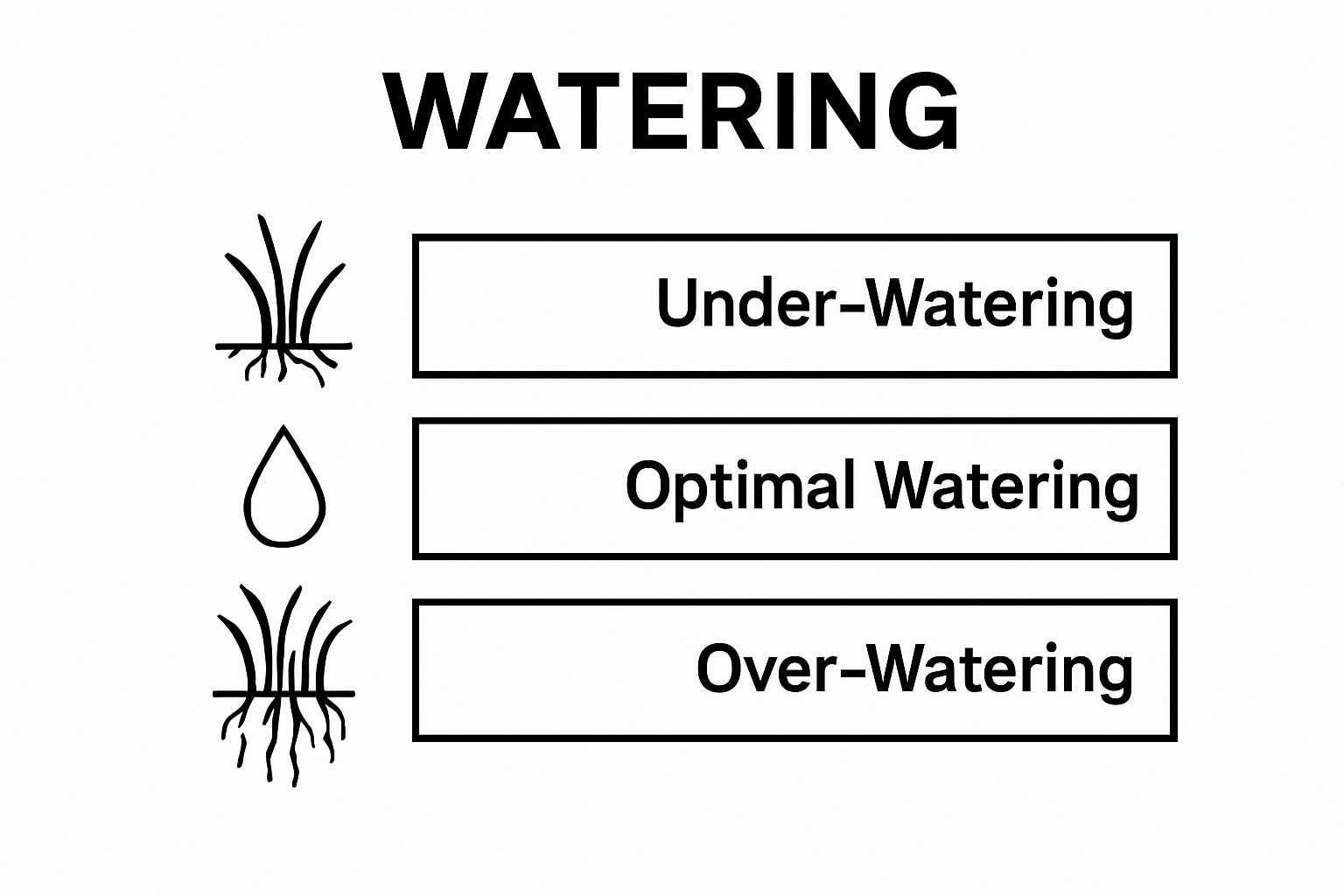
A well-designed watering schedule considers not just quantity, but timing, frequency, and environmental conditions to support optimal lawn health.
Why a Watering Schedule Matters for Lawn Health
A strategic watering schedule is more than just a routine maintenance task—it is a critical component of comprehensive lawn care that directly impacts the vitality, resilience, and long-term sustainability of your outdoor landscape. Understanding the profound connection between systematic hydration and turf health reveals why precise water management is essential.
The Impact of Water Management on Grass Physiology
Proper water scheduling influences grass growth at a fundamental biological level. According to Penn State Extension, inconsistent or improper watering can trigger multiple negative physiological responses in grass, including:
- Weakened root system development
- Increased susceptibility to disease and pest infestations
- Reduced drought tolerance
- Compromised nutrient absorption capabilities
These potential consequences underscore the importance of a meticulously planned hydration strategy that supports the intricate biological mechanisms of grass growth.
Preventing Long-Term Landscape Damage
Beyond immediate plant health, a structured watering schedule serves as a preventative measure against broader landscape degradation. Colorado State University Extension emphasizes that systematic irrigation helps create a robust turf ecosystem that can withstand environmental stressors.
Uncontrolled or random watering can lead to significant landscape challenges, including soil erosion, uneven growth patterns, and increased vulnerability to extreme weather conditions. By implementing a carefully calibrated watering approach, homeowners can mitigate these risks and maintain a healthier, more resilient lawn environment.
A comprehensive watering schedule is not merely about supplying water—it represents a holistic approach to lawn management that balances immediate plant needs with long-term ecological sustainability.
The following table compares the effects of proper versus improper lawn watering, summarizing physiological, soil, and landscape impacts discussed throughout the article.
| Aspect | Proper Watering | Improper Watering |
|---|---|---|
| Root System | Encourages deep, robust root growth | Causes weak, shallow roots |
| Disease Susceptibility | Reduces risk of fungal and pest issues | Increases risk of turf disease and infestations |
| Drought Tolerance | Improves resilience in dry conditions | Reduces ability to withstand drought |
| Soil Structure | Enhances aggregate stability and drainage | Leads to compaction and poor drainage |
| Nutrient Absorption | Supports effective nutrient uptake | Compromises nutrient absorption |
| Microbial Ecosystems | Promotes beneficial soil microbes | Disrupts soil microbe balance |
| Landscape Sustainability | Maintains even, resilient turf | Causes uneven growth and long-term damage |
How Watering Schedules Influence Soil Health
Watering schedules represent far more than simple moisture delivery—they are complex interactions between water, soil, and plant biology that profoundly shape underground ecosystem dynamics. Understanding these intricate relationships reveals how strategic hydration directly impacts soil structure, nutrient availability, and long-term landscape sustainability.
Soil Structure and Water Dynamics
The relationship between irrigation and soil health is fundamentally biochemical and structural. UF/IFAS Extension explains that excessive or poorly timed watering can dramatically alter soil composition, leading to significant environmental consequences.
Key soil health factors influenced by watering schedules include:
- Nutrient retention and leaching potential
- Soil particle aggregation and stability
- Microbial ecosystem balance
- Root zone oxygen availability
Improper water application can compact soil particles, reduce natural drainage capabilities, and create anaerobic conditions that compromise beneficial microorganism populations critical for nutrient cycling.
Chemical and Biological Soil Interactions
Precise watering schedules play a crucial role in maintaining delicate soil chemical balances. According to Penn State Extension, water chemistry directly impacts soil mineral composition, with factors like sodium levels potentially degrading soil structure over time.
Frequent, shallow watering disrupts natural soil processes by preventing deep root growth and limiting the soil’s capacity to develop robust, interconnected microecosystems. Professional landscapers recognize that strategic hydration supports complex underground networks that sustain healthy turf environments.
By understanding these nuanced interactions, homeowners can transform watering from a simple maintenance task into a sophisticated approach to landscape management that prioritizes long-term soil health and ecological balance.

Key Concepts of Effective Watering for Lawns
Effective lawn watering transcends simple moisture application—it requires understanding complex interactions between water, soil, grass physiology, and environmental conditions. Professional landscapers recognize that strategic hydration involves precise timing, volume, and technique to support robust turf health.
Understanding Water Volume and Frequency
North Carolina State University Extension emphasizes that established lawns typically require approximately one inch of water per week, distributed strategically to promote deep root development. This recommendation accounts for natural rainfall and requires careful measurement and calibration.
Key considerations for water volume include:
- Total weekly water requirement
- Soil type and drainage characteristics
- Grass species and root depth
- Local climate and seasonal variations
Uniform water distribution prevents uneven growth and reduces potential landscape stress. Homeowners should avoid single heavy applications, instead opting for multiple moderate irrigations that allow gradual soil absorption.
Timing and Application Techniques
The moment of water application significantly influences lawn health. University of California IPM recommends early morning irrigation—typically between 5 and 9 a.m.—to minimize evaporation and maximize water penetration.
Professional landscapers utilize advanced techniques like cycle-and-soak irrigation, which involves breaking water application into shorter intervals to prevent runoff and promote deeper soil moisture penetration. This method is particularly effective in clay-heavy or compacted soil environments, allowing water to gradually infiltrate without overwhelming the ground’s absorption capacity.
By understanding these nuanced watering principles, homeowners can transform lawn maintenance from a reactive task to a proactive, scientifically informed approach that supports long-term turf vitality.
The Impact of Climate on Lawn Watering Needs
Climate represents a dynamic and critical factor in determining lawn hydration requirements, transforming water management from a uniform practice to a nuanced, location-specific strategy. Understanding how regional environmental conditions influence turf water consumption enables homeowners to develop intelligent, adaptive irrigation approaches.
Climate Variability and Water Consumption
USDA Forest Service research reveals remarkable variations in lawn water use across different climatic zones. A comprehensive study examining 79 U.S. residential landscapes demonstrated that evapotranspiration rates can fluctuate dramatically—ranging from 0.6 to 3.6 millimetres per day—depending on local solar radiation, temperature, and humidity levels.
Key climate factors affecting lawn water needs include:
- Solar radiation intensity
- Ambient temperature ranges
- Humidity levels
- Wind exposure
- Seasonal precipitation patterns
These interconnected environmental variables create unique microclimate conditions that significantly impact a lawn’s water absorption and retention capabilities.
Developing Climate-Responsive Irrigation Strategies
The EPA’s WaterSense Program emphasizes the importance of climate-specific water budgeting. Successful lawn hydration requires continuous adaptation to local environmental conditions, moving beyond rigid, unchanging irrigation schedules.
Professional landscapers recognize that effective water management involves dynamic adjustments based on real-time climate data. This approach considers not just total water volume, but the complex interactions between grass type, soil composition, and regional meteorological patterns.
By understanding these intricate relationships, homeowners can develop sophisticated irrigation strategies that conserve water while maintaining optimal lawn health across diverse climatic landscapes.
Unlock Healthy Lawns With a Custom Watering Schedule
Struggling to keep your lawn green and resilient? Over-watering or inconsistent watering can weaken roots, waste water, and lead to disappointing turf results. As highlighted in the article “Understanding the Watering Schedule for Lawns”, successful hydration depends on knowing your soil composition, climate, and grass type. Without expert guidance, it is easy to fall into common pitfalls that leave your landscape looking uneven or prone to disease.

Let Ace Landscapes turn your frustration into a thriving green space. Our team specializes in professional lawn care and maintenance, including designing site-specific watering schedules that address Calgary’s unique climate and soil. We offer year-round landscape solutions, precision irrigation systems, and dependable property care for both homes and businesses.
Ready for a healthier, more beautiful lawn? Visit Ace Landscapes now to book a free estimate and see how expert planning can transform your property this season.
Frequently Asked Questions
What is a watering schedule for lawns?
A watering schedule for lawns is a strategic plan that outlines when and how much water to provide to grass and landscapes, ensuring optimal growth while conserving water.
How much water do lawns typically need?
Most residential lawns require about one inch of water per week, including rainfall, to maintain healthy growth and prevent damage from under or over-watering.
When is the best time to water my lawn?
Early morning, between 5 and 9 a.m., is the best time to water your lawn. This timing minimizes evaporation and reduces the risk of fungal diseases.
How does climate affect my lawn’s watering needs?
Climate significantly influences lawn watering needs, with factors like temperature, humidity, and solar radiation impacting how much water your lawn requires. It’s essential to adjust your watering schedule based on local environmental conditions.